Log in


A young woman rushes in with a puppy tucked under one arm. After the preliminary check-in process:
Owner: "I'm really worried. He's barely eating."
Vet: "How long has this been going on?"

|
I.T. grunt, barking at the moon.
|
A young woman rushes in with a puppy tucked under one arm. After the preliminary check-in process:
Owner: "I'm really worried. He's barely eating."
Vet: "How long has this been going on?"
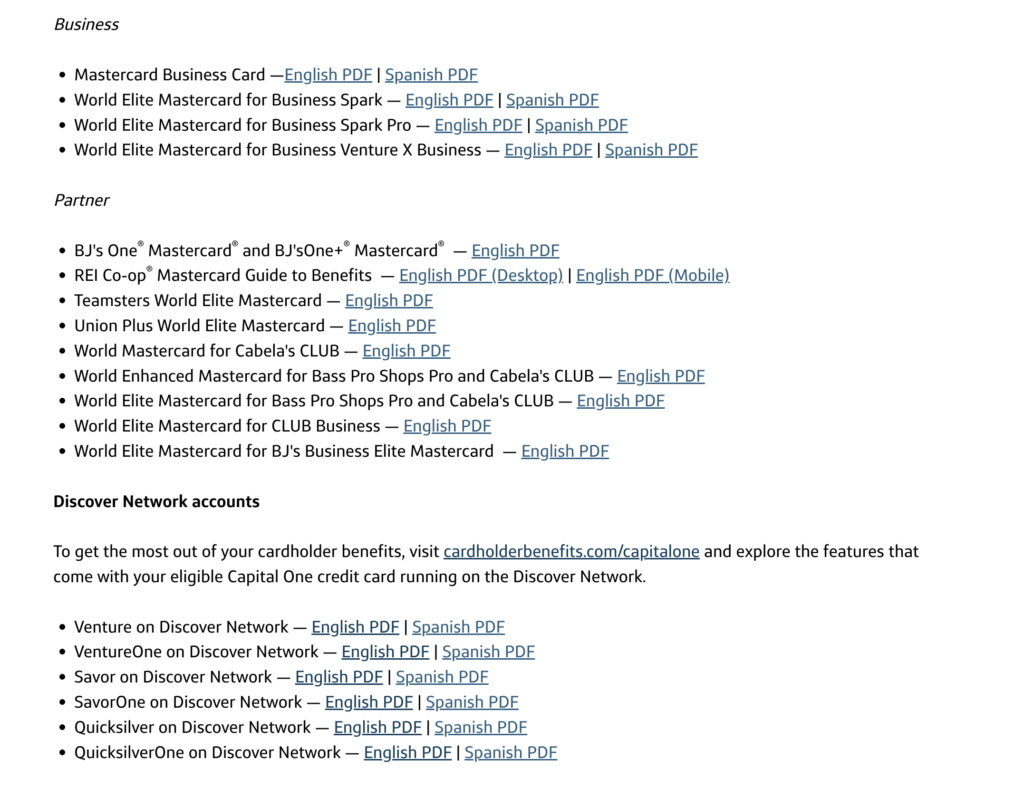
People noticed today that Capital One now has official PDF Benefits Guides for their Venture, Savor, and Quicksilver cards using the Discover network.
It appears from the benefits page that the bank might be moving over their Venture, Savor, and Quicksilver cards to the Discover network. Currently, these cards run on the Mastercard payment network. (Note: the Venture X consumer card is not specifically mentioned on that page at all.)
This comes after the merging of Capital One with Discover. And the issuance of all Capital One debit cards as Discover cards.
For now nothing has changed, but it’s a bellwether to Capital One shifting their cards over to the Discover network, possibly soon.
The same page still shows the Capital One business cards (including Spark and Venture) and their cobranded cards as Mastercards. And so apparently don’t have any plans of moving those to the Discover network soon.
Hat tip to reader FamilyTravelJohn


Michael Burry, of “Big Short” fame, recently shut down his hedge fund and started a Substack with an educational goal. I enjoy following his musings because he’s not afraid to say what he thinks, even if I often don’t agree (or have any idea what he’s obliquely referring to). He recently posted a “foundational” article that is supposed to show his thinking process, with a familiar beginning:
For those that do not trust anything analog, since 1990, there have been over 750 replacements in the S&P 500 Index. Google’s Gemini 3 Pro swears by it. Claude Max agrees.
Gemini 3 Pro and Claude Max further propose that 45% of the top 20 names in the 1999 NASDAQ 100 ended up bankrupt or acquired after a >75% loss. This checks out, my conference room says.
Capital is always fighting to be recycled.
Thusly, you now carry the knowledge that most investors are best off in an index – and have no need to invest in individual stocks.
If one is rather young and has 50-70 years left, then one absolutely should be almost entirely invested in common stock indices, preferably the S&P 500 or the Nasdaq 100 or both. Live life, touch grass, achieve real things, automatically reinvest dividends, and let the compounding of the Index Gods do the work. Maybe not this very day, but over time, this is the way for most.
Of course, some of us just do…not…want…easy.
For them, well, their God gave them GameStop.
He then goes very deep into how he analyzed GameStop and through skill and smarts, of course made some nice returns on the trade.
This is the central humblebrag of professional investors. *You* should index, but here’s what *I* do instead. If you are a motivated person who studies investing with an honest and open mind, you realize that you probably shouldn’t really be actively trading. But if you are a motivated person who studies investing, you probably think you are in the tiny minority that can make money reliably with actively trading. Smart enough to turn off “easy” mode.
This is the central struggle for all individual investors. The problem with “easy” is that it is also boring and often slow. Meanwhile, your Robinhood app or equivalent will happily sell you:
I spend a lot of my own time doing just this – reading across various corners in the investing world but repeatedly convincing myself to pick “easy”. I’ll read this article and enjoy it (update: it appears to have gone from free to behind a paywall since this writing), but I don’t need to analyze GameStop.
The Financial Times (a British newspaper) has a rare profile of Fidelity Investments (paywall, archive) with the title “Can Fidelity keep its grip on America’s investments?”. Fidelity is privately-held (49% by the founding Johnson family now in its third generation, 51% by employees) and they don’t seek the limelight. They didn’t grant an interview for this article, and they seem to only disclose the absolute minimum financial information about their company as required by law. I can respect that, but at the same time, I like to better understand the custodian of a big share of my net worth, so I read the article with interest. Here are my takeaways.
Fidelity’s longevity is at least partially due to its willingness to pivot with the times. They were once best known for their actively-managed mutual funds like Magellan, then became a 401(k) behemoth managing trillions, accepted low-cost passive investing options, and even today are more open to crypto than other big companies (a Fidelity stablecoin is coming). They don’t move crazy fast, but they do move thoughtfully.
They are willing to be different things to different people. They have some of the largest companies in the world as their customer through 401(k) plans, they are the home to very power financial advisors and their billionaire clients, and they also count tiny individuals like myself as clients who trade less than 10 times a year and only mostly low-cost (non-Fidelity) ETFs. They’ve somehow figured out how to balance all these activities and profit from them all:
Astute fee management has also played a part. “Fidelity is a full-fee, full-cost player, not a discounter like Vanguard,” the former employee says. “Abby [Johnson] has masterfully priced her services across asset classes, products and channels.”
Fidelity’s mutual fund fees are competitive. According to Morningstar Direct, the average asset-weighted cost of an active equity fund in the US is 0.59 per cent a year, compared with Fidelity’s 0.43 per cent. Among passive products the average is 0.10 per cent and Fidelity’s is 0.03 per cent.
Fidelity is able to take a longer-term view.
Even in the face of such challenges, its advocates say Fidelity has another important string to its bow. As a private, family-controlled company — Edward and Ned each ran it for over three decades — it is not subject to the demands of quarterly reporting and managing shareholder expectations, helping management to focus on longer-term strategy and innovation.
“I would say this is the secret sauce of the Johnson family,” the former employee says. “They think about 25-year periods. I’m sure [Abby’s] father was petrified about: how do I keep this thing going so that my daughter can take over?”
“As they prepare for the generation coming up behind Abby, they will be thinking about where the next 50mn [customers] are going to come from.
Overall, Fidelity has the vibe of the sober adult in the room. Not the crypto teenager that can take huge risks since they have nothing to lose. Not the young adult Robinhood trying to break things first and ask for forgiveness later. However, they are also not the old man who complains about everything new and refuses to change their habits out of stubbornness. Based on the new stuff I learned in this article, I still see Fidelity as a good long-term home for my investments.
 reply
reply